Blog Home
How to negotiate buying a car from a private seller
Get the best price for a car on the private market using a calm data-driven approach

Negotiating the price of a used car from a private seller isn’t about throwing out a low number and hoping it sticks. The most effective negotiations are calm, data-driven, and grounded in reality. Your goal isn’t to “win,” but to arrive at a fair price that reflects the car’s true condition, history, and market value.
Below is a practical framework you can use to build a strong, defensible offer that’s hard for a seller to argue with.
Learn about the car first
Before you talk numbers, do your homework. The basic idea is simple: start with a strong reference price for the car, then subtract anything that reasonably reduces its value. You don’t need to be perfectly precise, but you should be able to explain every adjustment you make using real information.
Find a solid starting price
Start by looking up the car on Kelley Blue Book and selecting the highest private party price in “excellent” condition. This will be your baseline.
Why use “excellent” even if the car isn’t perfect? Because condition is subjective. Starting at the top avoids double-counting issues later when you subtract for maintenance, repairs, and wear. It also makes your math easier to explain.
You can sanity-check this number by looking at similar local listings or other pricing tools, but KBB works well as a neutral reference point.
Subtract upcoming maintenance costs
Next, ask the seller about maintenance history. Even if they don’t have records, they should be able to tell you whether major services have been done recently.
Then look up the manufacturer’s recommended maintenance schedule for the car. A quick search like “[year make model] maintenance schedule” usually does the trick.
Pay special attention to higher-cost items that are mileage-dependent, such as:
- Brakes
- Tires
- Spark plugs
- Timing belts or chains (where applicable)
If these services are due soon or overdue, it’s reasonable to subtract their estimated cost from your starting price.
Subtract the cost of major repairs
If anything feels off when you drive the car or if warning lights are on, factor that into your offer.
The best way to do this is with a pre-purchase inspection from a trusted mechanic. An inspection typically includes a list of issues along with estimated repair costs, which gives you concrete numbers to work with.
If you skip the inspection, you can research typical repair costs online, but this is less precise. When possible, an inspection is well worth the money.
 Steven Gin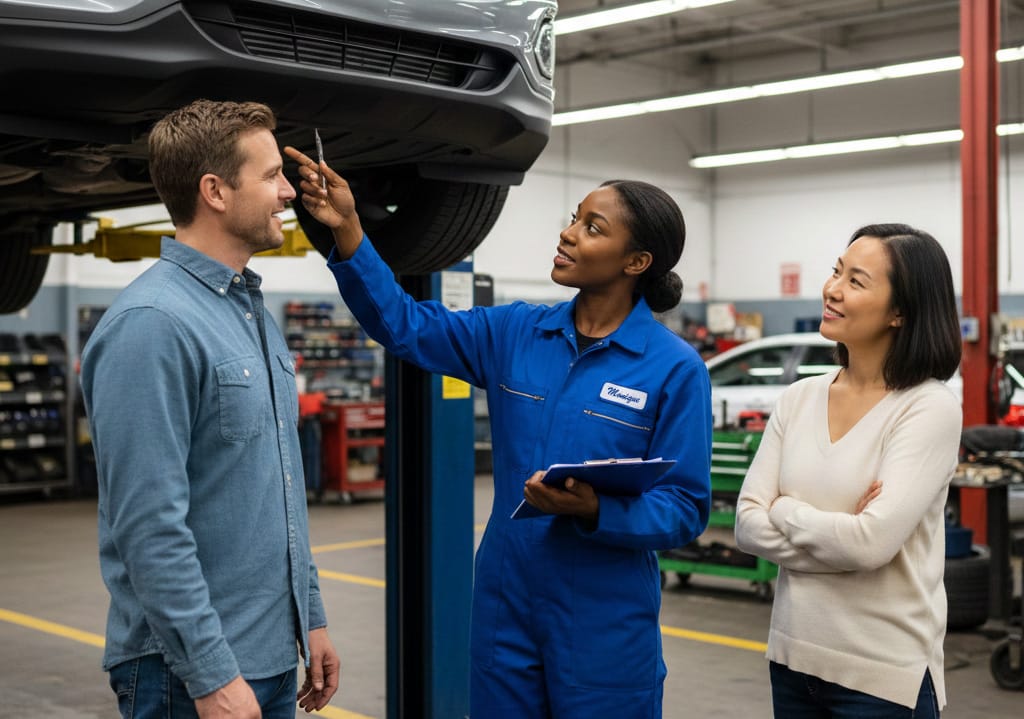
Account for cosmetic damage
Cosmetic issues are trickier. Scratches, dents, and worn interior surfaces don’t affect how the car drives, but they do affect value and resale potential.
A reasonable rule of thumb is to subtract around $300 per damaged body panel for common cosmetic issues. While professional repainting often costs much more, many sellers won’t accept a deduction equal to full repair costs. The right adjustment depends on the car and the buyer. A daily driver and a collector car will be treated very differently here.
Don’t ignore vehicle history
Vehicle history can significantly affect value. Always review the title status and consider purchasing a vehicle history report.
Branded titles, such as salvage or flood damage, usually lower a car’s value substantially. Accident history can also affect price, even if repairs were made properly.
KeySavvy includes a title report that checks for salvage records, mileage inconsistencies, and dozens of title brands. You may also want to review a CARFAX or AutoCheck report for accident history.
Not every issue is a deal-breaker, but any negative history should prompt deeper research and, at a minimum, factor into your negotiation.
Consider the local market and your priorities
Pricing guides are useful, but they don’t capture everything. Local demand, seasonality, and model popularity all matter.
In some markets, certain vehicles consistently sell above book value. A well-maintained, in-demand model may attract multiple buyers, especially if inventory is tight. In those cases, paying slightly more than a guide price doesn’t necessarily mean you’re overpaying.
Your own preferences matter too. If a car has the exact color, options, or configuration you’ve been searching for, it may be worth more to you than to the average buyer. Paying above book value isn’t automatically a bad deal, just as paying below it isn’t always a good one.
Present your offer clearly and calmly
When it’s time to make an offer, don’t just share a number. Share how you arrived at it.
A strong offer includes:
- Your starting price and why you chose it (for example, KBB private-party value in excellent condition)
- Each deduction you made for maintenance, repairs, cosmetic issues, or history
- Links or sources that support your estimates
This approach shifts the conversation from haggling to problem-solving. Sellers may not agree with every deduction, but they’re far more likely to engage when they can see the logic behind your offer.
Make sure you’re dealing with the right seller
Before you exchange money, confirm that the seller is the legal owner of the vehicle and that the title is clear. If the seller doesn’t have the title, if there’s an unresolved lien, or if their name isn’t on the registration, you could end up with a car you can’t legally register.
KeySavvy verifies vehicle ownership and seller identity before payment, helping reduce the risk of fraud or paperwork issues. If anything about the transaction feels off, it’s better to pause or walk away than to rush into a bad situation.
 Steven Gin