Blog Home
Private sale vs. trade-in
Is it better to trade-in your car or sell privately? An age-old question balancing time, convenience, and money.

If you’ve been thinking about getting a new car, you are likely wondering what the best option is for the one you have now. The answer—as you’ll see in this article—depends on what you value most: money or time.
The convenience value of a trade-in
If you have your eye on a vehicle at a dealership and you can simply deduct the trade-in value from the price you pay, this is the fastest and easiest thing to do. If you have very limited time, a dealer may be your best (and only) option.
Tax savings (sometimes) sweeten the deal
Most states charge tax on car sales and most states only charge tax on the amount you pay—that is, total price minus the trade-in.
Note that Alaska, Delaware, Montana, New Hampshire, and Oregon do not charge sales tax on vehicles. California does not allow the trade-in value to be deducted.
That means that in most states trading in can save you some money on taxes.
The calculation is simple:
(Trade in value) X (Tax rate) = Tax savings
So, if a dealer in Michigan (6% tax rate) offers you $7000 for your trade in, you will save:
$7000 * (.06) = $420
If this number is substantially large, you might consider taking the trade-in offer, especially keeping in mind the added convenience.
Selling privately will get the best price
We did some research that showed that you will on average get 46% more money from selling privately than from trading in to Carvana (this includes the tax savings mentioned above).
 Steven Gin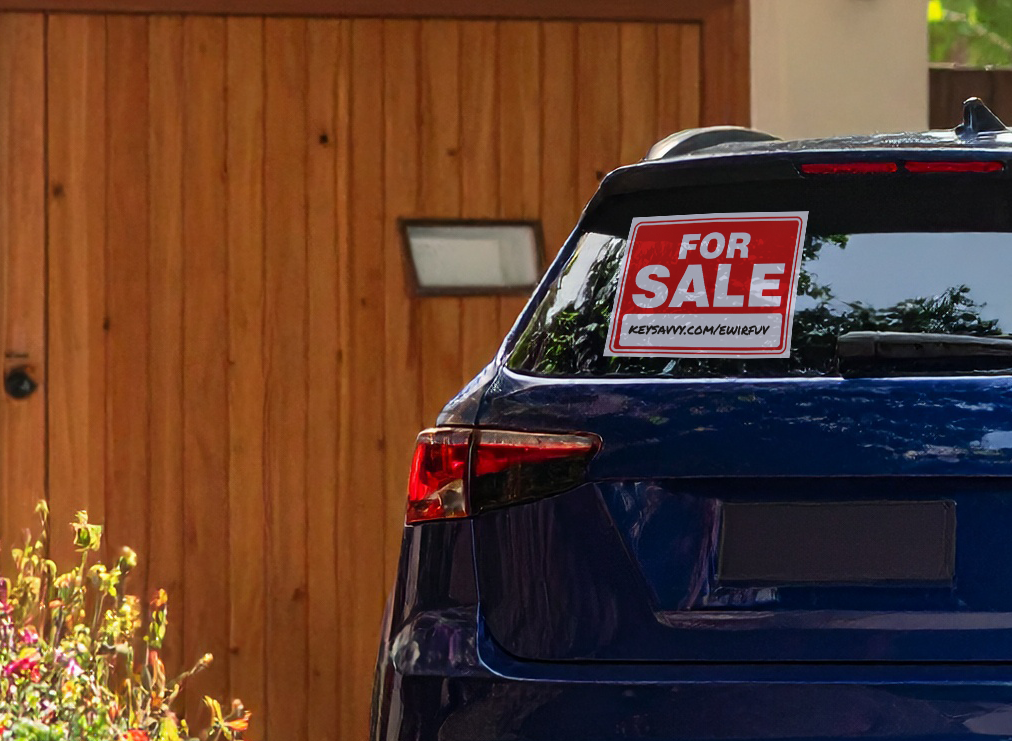
A 2021 article in Car & Driver resulted in a similar 39% higher value from private sale over the local dealer price (a difference of $5498 on a car worth about $20,000).
There is very little dispute of the fact that private sale is the way to getting the best possible price for your car. If you can spare the effort, you may very well be rewarded for it.
Private sales are more work and can be less safe
If you’re selling privately, you need to take care of a lot of little things that add up to a good amount of work:
- Write up an ad, take photos, post it on marketplaces
- Answer inquiries by phone, email, text
- Set up meeting, test drive, possible inspection, car hand off
- Arrange payment, possible DMV title transfer
 Steven Gin
In addition, selling privately exposes you to the potential of fraud and you cannot guarantee how long the car will take to sell.
 Steven Gin
Dealerships will generally offer the lowest price for trade ins, because they handle all the above for you, and also have overhead costs, plus the need to make a profit.
If you're thinking about trying to get a better price for your car on the private market, KeySavvy's platform is designed to make it safer and easier.
KeySavvy makes private car sales more convenient and secure
With KeySavvy, you can still get the best price for your used vehicle on the private market (minus our $198 fee, often split between buyer and seller). Here’s how it works:
- Find the buyer (steps 1-3 above).
- We verify the buyer’s payment and your title, securing both against fraud.
- If there is a lien on your title, we charge an additional $99 and pay it off.
- Once the keys are handed off, we release the funds to you and send the title to the buyer. We also provide a bill of sale.
- We provide the buyer with temporary registration so they can drive it home.
Selling privately doesn't have to be risky or inconvenient.
In review
There really is no one-size-fits-all answer to the question “should I trade or should I sell?” but the table below breaks down the major considerations.
Trade-in
- Worst value
- Most convenient
- Safe from fraud
Private sale (traditional)
- Best price
- Least convenient
- Risk of fraud
Private sale with KeySavvy
- Best price
- More convenient
- Safe from fraud
- $198 fee*
*often split between buyer and seller. Additional $99 fee applies if the title has a lien.
Whatever you decide, we’d encourage you to research what your car is worth if you sell it yourself before walking into a dealership.
 Steven Gin