Blog Home
What is a VIN?
Everything you need to know about the most important identification number for your vehicle
Introduction
VIN stands for Vehicle Identification Number.
There are many situations in which you will need to know a vehicle’s VIN. For example,
- To register it with the DMV
- To transfer or alter a title
- To insure it
- Mechanics use it to report service done to the vehicle
- To look up a report on the vehicle’s history—especially useful when buying or selling a used vehicle
- To sign up as a seller with KeySavvy and complete a secure private party sale
So, here is a roundup of the important information you might need to know about your VIN.
A very short history of the VIN
VINs began being used in the US in 1954, but were not standardized or required until 1981, when the National Highway Traffic Safety Administration (NHTSA) mandated that “all over-the-road-vehicles sold must contain a 17-character VIN.”
Since then, global automakers have conformed to a few different (but roughly similar) standards.
What does a VIN reveal?
A VIN contains details about the vehicle’s:
- Manufacturer
- Brand and vehicle type
- Model
- Body type
- Engine type
- Year of manufacture
- Factory location
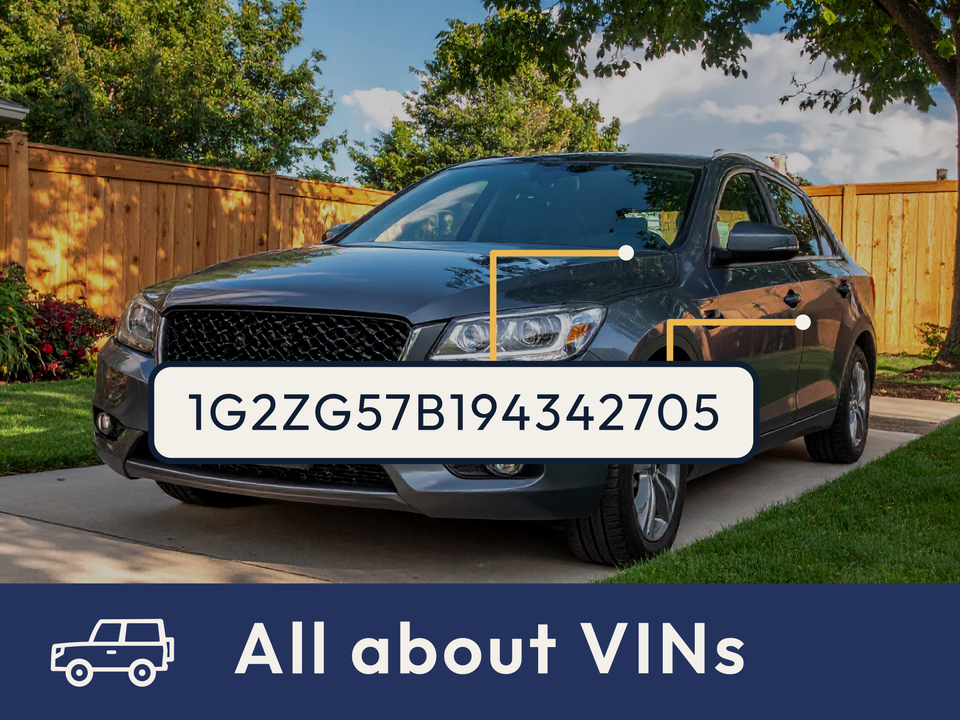
For example,
This VIN (randomly generated with vingenerator.org)
is for a 2012 Buick Enclave, premium trim, manufactured in the US.
A VIN also enables someone to obtain a vehicle history report from a company like CARFAX, Autocheck, or Bumper, usually for a fee. A vehicle history report checks for:
- Accidents the car has been in and damage it has sustained
- Service the car has received
- Types of use the car has had (personal, commercial, taxi, etc.)
- Ownership (number of owners, locations)
- Mileage Reports
- Title Brands (salvage, rebuilt, odometer rollback, flood, etc.)
As you can imagine, this information is extremely helpful in determining the value of a vehicle and it is highly recommended that you get a report before buying a car.
Where to find your VIN
- Your insurance card. If your wallet and insurance card are handy, your VIN is almost always on it. If your insurance provider has a mobile app, you can usually copy your VIN in the app.
- Your account on your insurance company’s website. Many established insurance companies have online portals, and your VIN is usually displayed somewhere on your account page. Log into your insurance website and find your insurance card or policy information.
- Your registration. Your annual registration will also have your VIN and it should be in your car (since it is required by law)—very likely in the glove compartment.
- Your title. If you own your car outright, you should have the title somewhere in your records (this should not be in your car, but kept in a safe place). You will find the VIN printed on this document.
- Your bill of sale. Whether you purchased your car from a dealer or a private seller (or even received it as a gift), there should have been a bill of sale created, and the VIN should be on it.
- Your email. You may have received an insurance quote or car repair receipt via email at some point. Try searching your email for the text "VIN" or your car's make and model ("BMW X3"). Sometimes you can get lucky.
- Your manufacturer or lender website. Some manufacturers, like BMW, provide you with online accounts that list the cars you own. Try logging in and searching for a section like "My Garage". If you financed your car, you might be able to log into your lender's website and find your VIN there too.
- Your car. Your VIN is in a few places on your car:
- On a sticker in the driver's door jamb. Pro tip: smartphones will let you copy the VIN right from a photo of this sticker.
- On a plate at the base of the windshield. The VIN plate can be seen from outside the car on the driver's side.
- Under the hood, stamped on the engine block.
- In the trunk, under the spare tire.
- Inside the rear driver’s side wheel well. If you got all the way here, you must be getting desperate!
When buying used cars, always check the VIN
If you are buying a used vehicle—especially from a private seller—you should always get the VIN for several reasons:
- Inconsistencies are a sign of fraud. If the VIN on the vehicle doesn’t match the VIN on the title or other documentation, this is a big red flag, suggesting that someone is or was trying to cover up something about the vehicle. Unless the seller can very convincingly reconcile the discrepancy, this is a good time to walk away.
- Vehicle history report. If you are interested in buying a vehicle, you should use the VIN to get a vehicle history report from CARFAX, Autocheck, or another such service. As mentioned above, a vehicle history report gives you a lot of information that can help you make a decision or negotiate a better deal—without having to take the seller’s word for it. It can also save you having to go look at a car, if you can rule it out. Knowledge is power!
Still can't find a VIN?
If the VIN on a car has been scratched off, removed, altered, tampered with, or otherwise obscured, this is a very bad sign. Besides being illegal, tampering with the VIN on a car is usually something done to conceal that the car was either stolen or damaged.
Among other problems:
- It may be impossible, difficult, or expensive to get it registered at the DMV.
- You will have no sense of its history or what structural and mechanical issues it could have.
- You cannot verify the odometer reading—e.g. it could have been rolled back.
- If it was stolen or involved in illegal activities, it can be subject to seizure by law enforcement.
- It will be very hard to resell.
If you have already purchased a vehicle whose VIN has been tampered with, you should inquire with your state DMV to see what can be done.
Should I include the VIN in my private sale ad?
In short, yes.
The information available to anyone that gets access to your VIN is not secret, sensitive, or particularly private. Registered dealers can use your VIN to verify your identity, but it is illegal for them to share this confidential information.
 Steven Gin